We see it on Atlanta jobsites more often than anyone wants to admit: a pavement design that looks perfect on paper fails within three seasons because the lab CBR was run on a sample that didn't match the actual subgrade moisture condition. The Piedmont residual silts across Fulton and DeKalb counties change character fast when water moves through them. A CBR value generated from an air-dried specimen isn't just inaccurate—it's dangerous. Before you lock in a pavement section for a GDOT review or a City of Atlanta permit, the soaked CBR protocol from AASHTO T 193 has to be the baseline. Our lab runs the full test sequence, and we see the soaked result drop 40 to 60 percent below the unsoaked number in the typical Cecil-Madison soil series that dominates the metro area. When the subgrade shows CBR below 3, we often recommend pairing the result with a CBR field test to verify in-situ strength before importing select fill.
In Atlanta's Piedmont residual soils, a soaked CBR result below 3 means you're designing for a subgrade that will pump water, not carry traffic.
Technical details of the service in Atlanta
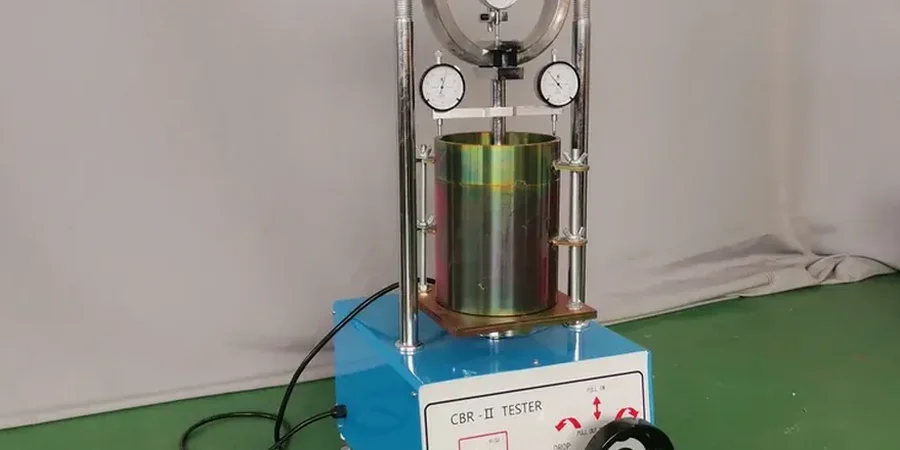
Field demonstration
Typical technical challenges in Atlanta
On a warehouse project off Fulton Industrial Boulevard last summer, the geotech report showed a design CBR of 8 based on unsoaked lab tests. The contractor placed 8 inches of GAB over the native subgrade. Twelve months later, the truck dock had 2-inch ruts. The real soaked CBR was 2.5, and the swell was nearly 3%. That's a half-million-dollar fix that a $200 lab test could have prevented. In our experience, the risk compounds when the pavement design follows the AASHTO 1993 method, because that equation is unforgiving with low CBR inputs—the structural number demand jumps sharply below CBR 4. We always advise running the soaked CBR on at least three points across the site, especially where the grading plan cuts into the B-horizon clay. Atlanta's topography means cut-fill transitions are everywhere, and the CBR in the cut is almost always worse than the fill.
Our services
Our Atlanta lab handles the full CBR workflow from sample receipt to pavement design input. We work with the soils you actually have on site, not idealized specimens.
Soaked Laboratory CBR (AASHTO T 193)
Three-point CBR family with 96-hour soak, swell measurement, and moisture-density relationship using standard or modified Proctor. We report both 0.1-inch and 0.2-inch values with correction where applicable, plus the swell-versus-time curve.
CBR with Gradation and Atterberg Package
Combined lab package for subgrade characterization: soaked CBR, particle-size analysis from 3-inch to No. 200 sieve, and liquid/plastic limits. Gives you the full picture for classifying the soil by AASHTO M 145 and predicting its performance under repeated loading.
Common questions
What does a laboratory CBR test cost in Atlanta?
A single-point soaked CBR test in our Atlanta lab typically runs between US$140 and US$230, depending on whether we are running standard or modified Proctor compaction and whether the package includes swell monitoring and gradation. A three-point family with all associated data is at the upper end of that range.
Why does GDOT require soaked CBR instead of unsoaked?
Because Georgia's climate puts water under the pavement. The water table rises and falls through the saprolite, and the subgrade will eventually reach near-saturation under an impermeable asphalt surface. The soaked test simulates worst-case moisture, and GDOT bases its structural design on that number to avoid premature rutting.
How long does the lab CBR test take from sample drop-off to report?
The full sequence—compaction, 96-hour soak, and penetration—takes five working days minimum. If we need to run a companion Proctor first to establish the target moisture and density, add one extra day. Expedited turnaround is possible, but you cannot shorten the soak period and still comply with AASHTO T 193.
What CBR value should I expect in Atlanta's residual soils?
In the Piedmont weathered schist and gneiss typical of Atlanta, we commonly see soaked CBR values between 2 and 8 for the natural subgrade, with the lower end in the micaceous silts of the Cecil-Madison series. Chemically weathered rock at the C-horizon can deliver soaked CBR above 20, but you rarely encounter that within the top 3 feet of a grading cut.
Can you run a CBR on aggregate base material?
Yes, we test graded aggregate base per ASTM D1883 as well. The mold is 6 inches in diameter, which limits the maximum particle size to 3/4 inch. If your GAB or crusher run has oversize, we scalp it on the 3/4-inch sieve and note the correction. GDOT Section 800 base typically yields soaked CBR above 80 when compacted to 100% standard Proctor.