Construction in Atlanta means dealing with the Piedmont's weathered profile. You might hit competent rock at 20 feet on one lot, then find 60 feet of silty saprolite across the street. That residual soil, formed in-place from decomposed granite and gneiss, often carries just enough fines to drain poorly during vibro-installation. We routinely specify stone columns here not as a universal fix, but as a calculated trade-off: the columns densify the matrix, create radial drainage, and transfer load past the most compressible horizons. A CPT test beforehand reveals thin seams that standard SPT split-spoon sampling misses, which directly controls the bottom-of-column elevation we detail on the construction drawings.
Stone columns in Atlanta's saprolite aren't just about densification; the drainage function often governs the design, cutting consolidation time from months to days.
Technical details of the service in Atlanta
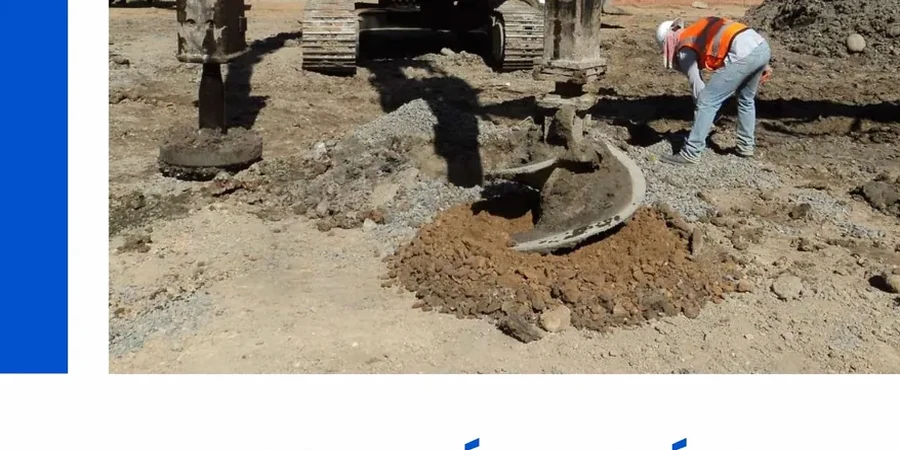
Field demonstration
Typical technical challenges in Atlanta
ASCE 7-22 and the 2018 IBC, as adopted by the City of Atlanta, require ground improvement designs to address both static and seismic load cases. The Piedmont saprolite presents a specific risk: its natural structure includes relict joints and foliation planes that can collapse during column installation, creating a temporary loss of lateral confinement. If the stone column bulges into these softened zones under cyclic loading, the composite ground stiffness degrades non-linearly. We model this using a unit-cell approach with strain-compatible shear modulus reduction curves from Seed & Idriss, cross-checked against CPT-based liquefaction triggering per Boulanger & Idriss (2014) when the groundwater table sits within 15 feet of grade. Atlanta's moderate seismicity means peak ground accelerations of 0.12g to 0.15g at the 2,475-year return period, so post-improvement liquefaction factor of safety must exceed 1.2 per IBC Section 1803.5.12.
Our services
Our Atlanta-area ground improvement services cover the full project lifecycle, from feasibility assessment through post-treatment verification. Each scope is tailored to the specific saprolite profile encountered at the site.
Feasibility and Preliminary Design
Review of existing geotechnical data, identification of problematic horizons, and preliminary column layout using Priebe method. Includes settlement estimates and cost-benefit comparison against deep foundations.
Final Design and Construction Documents
Detailed stone column grid, depth schedule, backfill gradation, installation method specification (wet top-feed, dry bottom-feed), and quality control testing requirements. Stamped drawings for City of Atlanta permit submission.
Post-Treatment Verification Testing
SPT and CPT correlation borings, modulus load tests on single columns and column groups, and settlement monitoring plans to confirm design improvement ratios are achieved in the field.
Common questions
What does stone column design typically cost for an Atlanta commercial project?
Engineering fees for stone column design in Atlanta generally range from US$1,640 to US$5,750 depending on the building footprint, number of borings to analyze, and seismic demand level per IBC. A 30,000-square-foot footprint with four borings typically falls in the middle of that range.
How do you verify the stone columns actually work in Atlanta's saprolite?
We specify post-treatment SPT borings at 28 days minimum after installation, targeting the centroid between columns where improvement is lowest. Acceptance criteria are a minimum SPT N1,60 of 15 blows per foot and a modulus load test deflection under 0.5 inches at 150% of design load.
Can stone columns replace deep foundations entirely in the Atlanta area?
In many cases, yes. For bearing pressures up to 6 ksf and saprolite with SPT N-values above 4, stone columns often eliminate the need for driven piles or drilled shafts. The key variable is the presence of boulders; if refusal is frequent, we may recommend a hybrid approach with select footings.
What installation method do you use for Atlanta's silty residual soils?
Wet top-feed vibro-replacement is the preferred method in Atlanta's micaceous silts. The water jet stabilizes the hole during penetration through collapsing zones, and the stone is introduced at the ground surface and flushed down the annulus. Dry bottom-feed is only viable in stiffer, non-collapsing saprolite.