Atlanta sits on the Piedmont physiographic province, where the real challenge for structural engineers begins about 15 to 40 feet below grade. That transition zone between residual silty clay and partially weathered gneiss is where most foundation problems start. The water table across Fulton and DeKalb counties fluctuates seasonally, often perched within the upper weathered mantle, which complicates shaft stability during drilling. We have seen too many projects where a uniform bearing stratum was assumed, only to find dipping rock surfaces and variable refusal depths across the same building footprint. A CPT test can map the soft zones continuously before you commit to pile lengths, while grain-size analysis of the residual soil helps confirm drainage behavior around the shaft.
Refusal depth in Atlanta Piedmont can vary 12 feet within a single building footprint. We design for that variability, not against it.
Technical details of the service in Atlanta
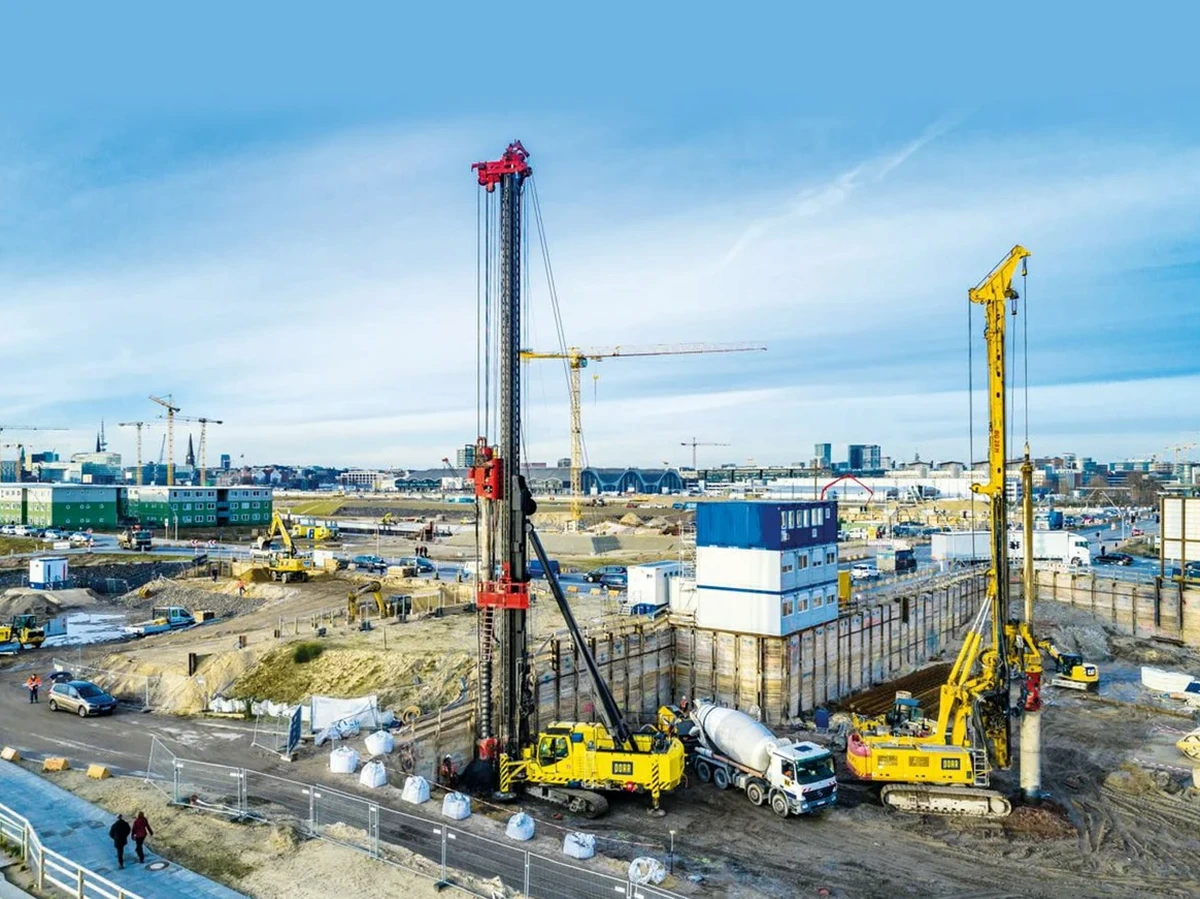
Typical technical challenges in Atlanta
A mid-rise mixed-use project near the Westside BeltLine encountered groundwater perched at the soil-rock interface, with artesian pressure during shaft drilling that triggered sidewall ravelling before the steel casing could be set. The contractor lost 36 hours of production, and the initial design assumed a dry open hole method that simply would not work on that site. We revised the construction sequence within 48 hours, switching to a temporary casing method with polymer slurry to stabilize the weathered zone, and adjusted the concrete mix for a tremie pour under water. That experience reinforced what we see repeatedly in this part of Georgia: the weathered mantle behaves more like a sensitive soil than a competent rock, and pile design must account for construction-phase stability, not just axial capacity. A proactive slope stability assessment of the adjacent excavation also prevented movement toward the neighboring historic warehouse foundation.
Our services
Our pile foundation design process for the Atlanta metro area covers the full engineering workflow, from initial subsurface characterization through construction-phase support. Each deliverable is stamped by a Georgia-licensed Professional Engineer with experience in Piedmont residual soil behavior.
Axial and Lateral Pile Capacity Analysis
We compute side friction and end bearing using FHWA and AASHTO methods, calibrated to site-specific rock coring and pressuremeter data. Lateral response is modeled in LPILE using p-y curves adjusted for the stiffness contrast between the residual soil and the underlying rock.
Construction Submittal and Integrity Testing Review
We review contractor means and methods, temporary casing design, tremie concrete specifications, and cross-hole sonic logging or thermal integrity results to confirm shaft continuity and nominal diameter throughout the weathered zone.
Common questions
What is the typical cost range for a pile foundation design in Atlanta?
For a standalone commercial building or mid-rise structure in metro Atlanta, the geotechnical design package including field investigation coordination, capacity calculations, and stamped construction drawings typically falls between US$1,460 and US$5,530. The spread depends on the number of borings, the depth and complexity of the rock profile, and whether lateral load or seismic analysis is required.
How deep do piles usually go in the Atlanta area?
It depends entirely on the depth to competent rock at the site. In downtown and Midtown, we often see refusal between 30 and 55 feet, but in areas near the Chattahoochee River or in the southern metro counties, the weathered zone can extend deeper, pushing pile lengths beyond 70 feet before reaching rock with an RQD above 50 percent.
Which pile type works best in Piedmont residual soils?
Drilled shafts with temporary casing are the most common solution because they handle the transition from soil to weathered rock cleanly. Driven H-piles work well when the weathered zone is thin and you can seat the pile tip in rock with a few feet of penetration. Micropiles are increasingly used for underpinning and sites with limited access, especially in tight intown lots.
How do you evaluate the rock socket length for a drilled shaft?
We base the socket length on the rock quality designation from the core run, the unconfined compressive strength of the rock, and the required side shear resistance. For the Atlanta Piedmont formation, we typically model the rock as a fractured, foliated material and apply the FHWA O\'Neill and Reese method, adjusting the beta factor based on rock mass properties observed in the core.