Around Atlanta, the first thing we notice on a site walk is how fast the soil character changes from one lot to the next. You can hit stiff red silty clay at three feet in Buckhead and then find completely weathered rock at six feet in Midtown — that's just the Piedmont geology playing its cards. An exploratory test pit lets us get down into the profile with our own eyes, log the residual soil horizon, measure the depth to partially weathered rock, and collect undisturbed bag samples right from the face of the excavation. When the IBC requires a foundation investigation but access is too tight for a drill rig, we bring the excavator and open a pit that answers more questions in two hours than a boring log sometimes does in two days. Before scheduling the machine, it is common to run a quick MASW survey across the building pad to identify shear-wave velocity contrasts that might indicate a buried boulder zone or a deeper saprolite pocket.
Visual logging of a test pit face reveals the saprolite transition zone far more accurately than SPT blow counts alone.
Technical details of the service in Atlanta
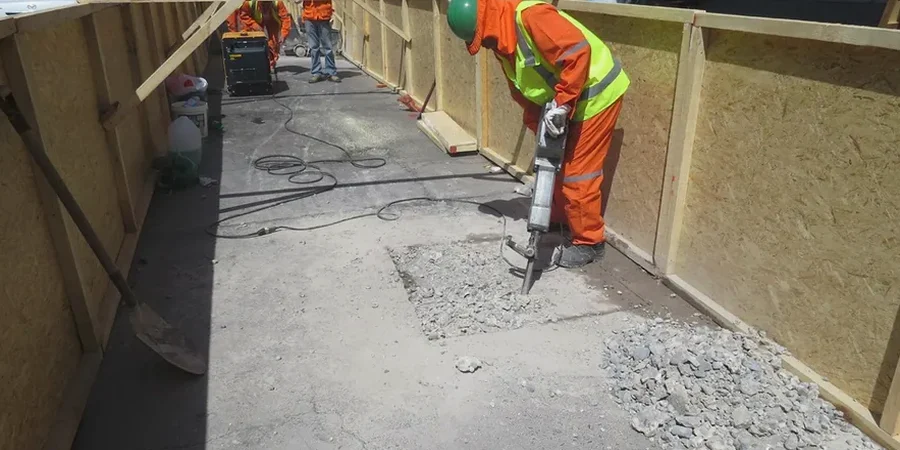
Typical technical challenges in Atlanta
Metro Atlanta sits around 1,050 feet above sea level on a deeply weathered Piedmont plateau where the saprolite layer can retain water like a sponge, especially during the long humid summers. In our own pit logs, we have seen perched groundwater appear at six feet in August and disappear by October, which means a single observation without seasonal context can mislead the drainage design. The biggest geotechnical risk we deal with is not the rock itself but the transition zone: partially weathered material that looks competent in the bucket yet slakes into soft clay within days of exposure to air and rain. If that zone is misidentified during a quick site visit, the contractor ends up over-excavating or placing footings on material that loses bearing capacity after a heavy downpour. We also watch for old urban fill — brick fragments, cinders, buried stumps — that predates current Atlanta grading ordinances and shows up in pits opened near historic streetcar corridors. Our practice is to document these conditions with high-resolution photos tied to GPS coordinates, because a picture of the pit face often carries more weight with the permitting office than a written description.
Our services
Every exploratory test pit we open in Metro Atlanta feeds directly into the broader geotechnical design process. These are the field services we run alongside or immediately after the pit investigation.
Residual Soil Profile Logging
We measure and describe each horizon exposed in the pit face — topsoil, residual clay, saprolite, and partially weathered rock — with Munsell color notation and field strength tests performed at the excavation.
Pit Floor Sampling and Laboratory Routing
We collect bulk bags from targeted strata and, where access allows, push thin-wall Shelby tubes into the pit floor for strength and consolidation testing at our accredited lab.
Seepage and Seasonal Groundwater Monitoring
We document perched water strike depth during excavation and, on longer-duration projects, install simple standpipe piezometers in the backfilled pit to track seasonal fluctuation.
Common questions
How deep can you excavate a test pit in Atlanta's Piedmont soils?
With a standard mid-size excavator we typically reach 8 to 14 feet below existing grade before the bucket starts fighting partially weathered rock. If the site has room for a long-reach arm and slope-back benching, we can push to 18 feet. The practical limit in Metro Atlanta is usually the top of the saprolite, because hard rock requires a hammer attachment and at that point a drill rig becomes more efficient.
What does an exploratory test pit cost in the Atlanta area?
For a standard pit excavated, logged, sampled, and backfilled in one day, the range we see across Fulton, DeKalb, and Cobb Counties runs between US$520 and US$880. The final number depends on access, depth, whether we need traffic control or hydro-excavation near utilities, and how many bag samples the lab testing plan requires.
Do I need a permit to open a test pit on my property in Atlanta?
In most cases yes. The City of Atlanta and surrounding counties require a land disturbance permit or an encroachment permit if the pit is within the public right-of-way. We handle the utility locate requests through Georgia 811 before any machine work starts, and we can advise on the local permitting path, but the permit itself is typically pulled by the owner or the civil engineer of record.
How do you backfill the pit and restore the surface afterward?
We backfill in lifts not exceeding 12 inches, compacting each lift with the excavator bucket or a vibratory plate compactor where access permits. The final lift gets crowned slightly above grade to allow for settlement. If the surface was pavement, we saw-cut the perimeter cleanly before excavation and the owner arranges for a hot-mix patch after backfill.