The International Building Code (IBC) and ASCE 7 set stringent requirements for earth retention systems, particularly in urban zones with variable subsurface profiles. Atlanta's geology, characterized by the transition from Piedmont residual silts to partially weathered gneiss and schist, demands a design approach that accounts for saprolitic soil behavior and the presence of groundwater perched within the soil-rock interface. In our experience, a deep excavation here is never a textbook case. The stiffness of decomposed rock can vary dramatically within a single city block, meaning a design that works in Midtown may require significant recalibration for a site near Buckhead. Proper site characterization with SPT drilling and laboratory strength testing on undisturbed Shelby tube samples becomes the cornerstone of any reliable earth support system before a single shoring element is sized.
The saprolitic transition zone in Atlanta's Piedmont profile behaves as a soil during excavation but a weak rock under confining pressure, requiring a dual-parameter design model to avoid wall kick-out.
Technical details of the service in Atlanta
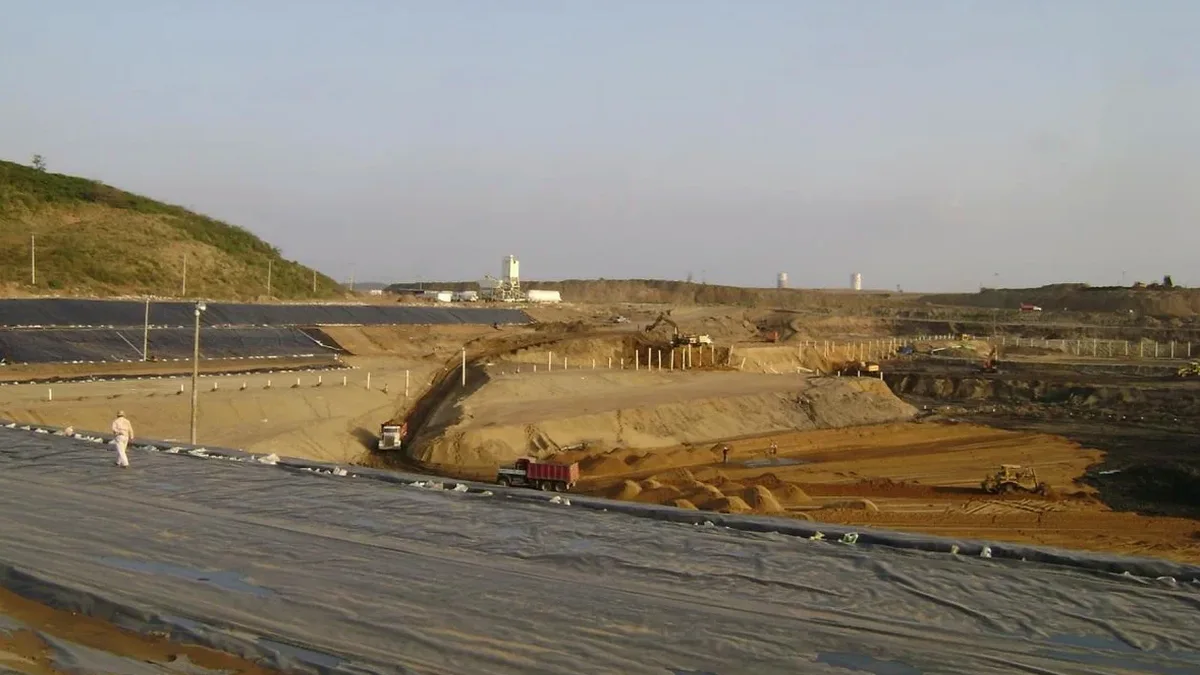
Field demonstration
Typical technical challenges in Atlanta
The humid subtropical climate of North Georgia introduces a critical variable: intense, short-duration rainfall events that saturate the near-surface residual soils and can trigger raveling between lagging boards or erosion behind a soil nail facing. This contrasts sharply with the dry conditions assumed in many drained design parameters. Failure to account for transient perched water in the upper 10 to 15 feet of the Piedmont profile is a recurring cause of construction-phase instability we have reviewed in forensic evaluations. A solid design must include a positive drainage strategy behind the wall, not just weep holes, but continuous geocomposite drainage layers and, where the excavation intercepts the water table, a pre-construction dewatering program verified by in-situ permeability tests. The risk of basal heave in deep cuts through soft alluvial pockets along the Chattahoochee River corridor also warrants a careful basal stability analysis using undrained shear strengths from field vane tests.
Our services
The design process for a deep excavation in the Atlanta market moves from a thorough understanding of the Piedmont residual profile to a detailed structural and geotechnical analysis. The services listed here reflect the sequential engineering tasks required to take a project from feasibility to a permitted, buildable set of construction documents.
Earth Retention System Design and Analysis
Full design of cantilever, anchored, and braced excavation support systems using beam-on-elastic-foundation (PYWall) and 2D finite element (Plaxis) methods. We develop apparent earth pressure envelopes calibrated to Atlanta's saprolitic soils, detailing soldier beam spacing, waler sizing, and tieback bond lengths within the weathered rock zone. The design package includes a constructability review addressing the high mica content of Piedmont soils, which can complicate drilled shaft installation.
Dewatering, Instrumentation, and Construction Phase Monitoring
Design of groundwater control systems specifically for the low-yield, fracture-flow aquifers typical of the Atlanta metro area. We specify a combination of deep wells and vacuum-assisted systems where fine-grained saprolite retains perched water. The service includes an instrumentation plan with inclinometers, optical survey points, and vibrating wire piezometers, paired with threshold action levels for wall deflection and groundwater drawdown that trigger contingency measures.
Common questions
What is the difference between designing an excavation in Atlanta's Piedmont soil versus coastal plain sediments?
The primary difference lies in the transition from a soil-like to a rock-like material within a single excavation depth. In the Piedmont, you are often cutting through residual silty sands and saprolite that still retain the structure of the parent gneiss or schist. This material has a high in-situ cohesion that degrades significantly with disturbance and exposure to water. Coastal plain sediments, by contrast, behave more predictably as sedimentary layers. In Atlanta, our designs must address the mica-rich, erosive nature of the soil and the perched water that collects at the soil-rock contact, which requires a more conservative drainage and facing design than a purely granular soil would demand.
When is a secant pile wall required instead of a soldier pile and lagging system?
A secant pile wall becomes necessary in Atlanta primarily under two conditions: when the excavation extends below the permanent groundwater table in an area where dewatering is restricted, or when the excavation directly abuts a structure that cannot tolerate any ground loss. The sandy silt of the Piedmont can ravel through the gaps in a soldier pile wall if the soil is loose or if fine-grained lagging is not meticulously installed. For deep cuts near MARTA tunnels or historic buildings downtown, the stiffness of a secant wall and its ability to cut off groundwater inflow provides the required control of lateral movement and surface settlement.
How much does a geotechnical design for a deep excavation typically cost in the Atlanta area?
The engineering fee for a complete deep excavation design package, including subsurface interpretation, shoring analysis, dewatering design, and preparation of sealed construction documents, generally ranges from US$2,130 for a limited-scope single-wall analysis to US$9,610 for a complex urban excavation with multiple bracing levels and a full instrumentation plan. The final cost depends on the excavation depth, the number of retaining walls, and the complexity of the structural connections to internal bracing or tiebacks.
What level of wall deflection is considered acceptable for an excavation adjacent to an existing building in Atlanta?
For a building on spread footings within the zone of influence, we typically limit the maximum lateral wall deflection to 0.5% of the excavated height. For a 30-foot cut, this translates to roughly 1.8 inches. In the Piedmont saprolite, the majority of movement occurs during the lagging installation and pre-stressing stages, not as long-term creep. Where the adjacent structure is supported on deep foundations extending below the excavation subgrade, we can often relax this criterion to 1.0% of the wall height, but we always conduct a detailed building condition survey and settlement analysis to confirm the tolerance.