Foundation engineering in Atlanta is far more than placing concrete in the ground—it is the critical discipline that transfers structural loads safely into the earth while contending with some of the most challenging subsurface conditions in the southeastern United States. This category encompasses the analysis, design, and detailing of systems that support everything from single-family homes in Buckhead to high-rise towers in Midtown. In a region where the Piedmont geology governs behavior, a deep understanding of residual soils, weathered rock, and groundwater variability is essential. Our practice covers the full spectrum of foundation types, including deep pile foundation design for heavy or settlement-sensitive structures, raft and mat foundation design for poor near-surface soils, and shallow foundation design when competent bearing strata lie within reach.
Atlanta’s subsurface is dominated by the Piedmont physiographic province, characterized by residual silts and clays derived from in-place weathering of metamorphic and igneous bedrock. These soils often exhibit high plasticity, shrink-swell potential, and variable thickness, with partially weathered rock and competent gneiss or granite at depths ranging from a few feet to over 100 feet. The transition zone known as saprolite presents particular challenges because it can behave like soil during excavation but like rock under foundation loads. Groundwater is typically encountered within the upper weathered zone, and perched water tables are common after heavy rainfall, making dewatering and buoyancy control central to any foundation design strategy in the metro area.
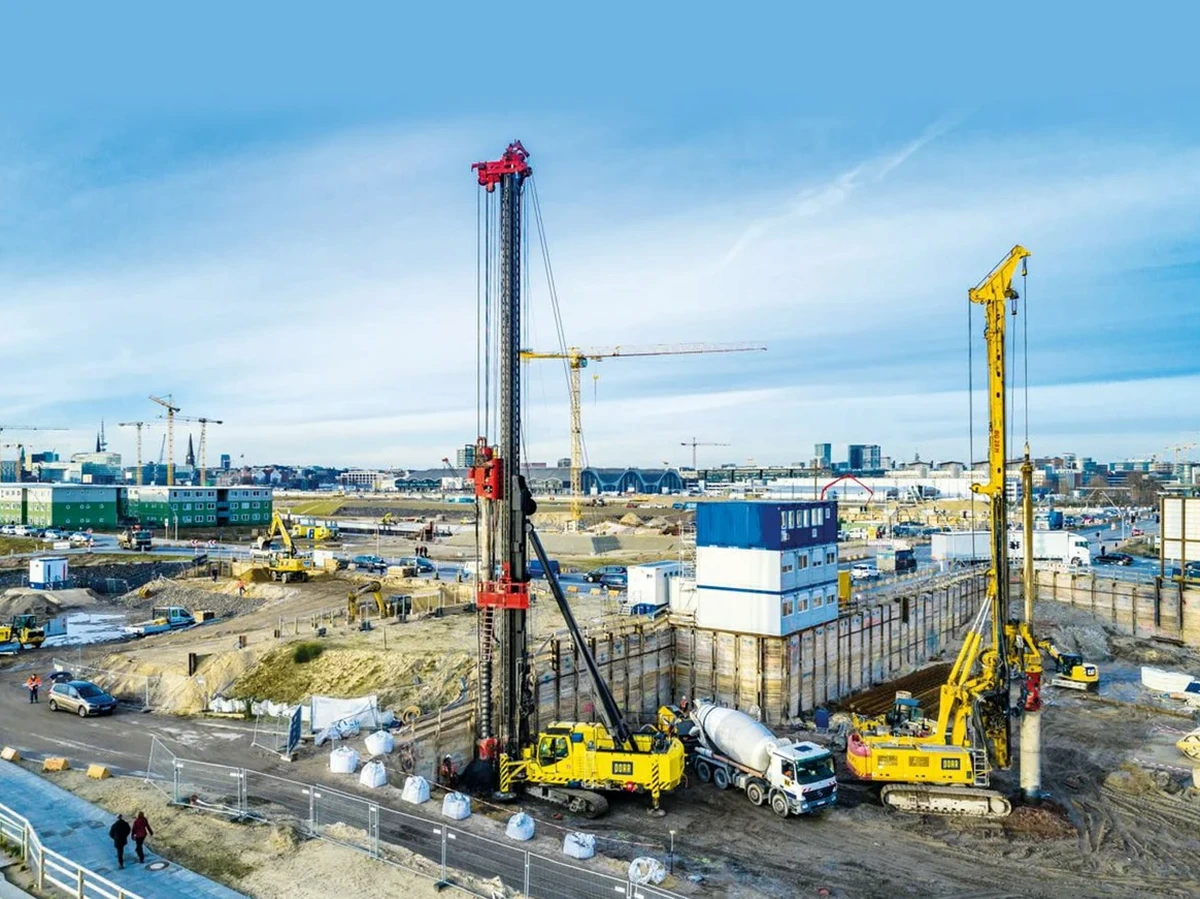
All foundation work in Atlanta falls under the Georgia State Minimum Standard Building Code, which adopts the International Building Code with state-specific amendments. The IBC references ASCE 7 for load combinations and geotechnical strength design, and ACI 318 for structural concrete. Local jurisdictions including the City of Atlanta, Fulton, DeKalb, and Cobb Counties may enforce additional plan review requirements and special inspections. Geotechnical investigations must comply with IBC Chapter 18, and foundation designs are typically based on allowable stress design methodologies unless project specifications require load and resistance factor design. For deep foundations, adherence to FHWA and AASHTO standards is common on public works, while private developments often follow recommendations from the Deep Foundations Institute.
Projects requiring comprehensive foundation design span every sector of Atlanta’s built environment. Low- and mid-rise residential developments on expansive soils frequently demand stiffened raft systems or ground improvement, while commercial buildings in dense urban corridors like the Perimeter Center rely on drilled shafts or micropiles to navigate underground utilities and adjacent structures. Infrastructure projects—bridges, retaining walls, water tanks—require rigorous consideration of lateral loads and scour, and industrial facilities with heavy crane loads or vibration-sensitive equipment need dynamic analysis integrated into the foundation solution. Even temporary works such as tower crane bases and excavation support systems fall within this category’s scope, underscoring the breadth of expertise required to serve the Atlanta market responsibly.
Common questions
What are the most common geotechnical challenges for foundations in Atlanta?
The dominant challenges are residual Piedmont soils with high shrink-swell potential, variable depth to bedrock, and the presence of saprolite—a transitional material between soil and rock. These conditions can cause differential settlement and heave, requiring thorough site investigation and often deeper or stiffened foundation systems. Perched groundwater and rapid weathering of excavated rock also complicate construction and demand careful water management during foundation installation.
Which building code governs foundation design in Atlanta?
Foundation design in Atlanta follows the Georgia State Minimum Standard Building Code, which adopts the International Building Code with Georgia-specific amendments. The IBC references ASCE 7 for loading, ACI 318 for concrete design, and Chapter 18 for geotechnical investigation requirements. Local county and city amendments may impose additional plan review, inspection, or reporting obligations that designers must incorporate.
How do I determine whether my project needs a shallow or deep foundation?
The decision depends on the bearing capacity and settlement characteristics of near-surface soils, the magnitude and distribution of structural loads, and tolerance to movement. Shallow footings may be suitable where competent soil or rock lies within a few feet of grade. When upper soils are weak, expansive, or highly compressible, deep foundations such as driven piles or drilled shafts are specified to transfer loads to more competent strata at depth.
What role does a geotechnical investigation play in foundation design?
A geotechnical investigation is the foundation of the design itself—it provides soil stratigraphy, strength parameters, compressibility data, and groundwater information needed to select and size foundations. Without an adequate investigation aligned with IBC Chapter 18, designs risk excessive settlement, bearing failure, or heave. In Atlanta’s variable Piedmont geology, borings, test pits, and laboratory testing are essential to reduce uncertainty and ensure safe performance.