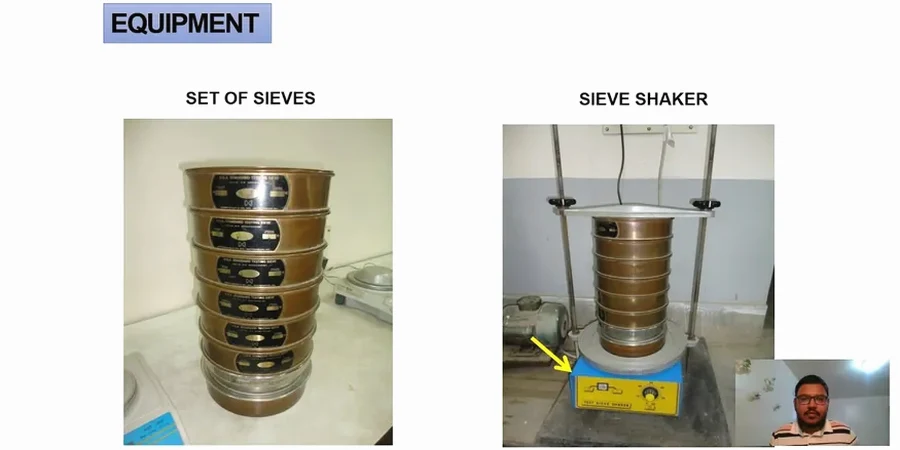
A stack of eight-inch brass sieves sits on a Ro-Tap shaker in our lab, working through 500 grams of oven-dried Atlanta soil. The mechanical pulse lasts about ten minutes. After that, each sieve gets weighed to 0.01-gram precision, and the fraction passing the No. 200 sieve moves to a hydrometer cylinder for the fines phase. Atlanta's Piedmont residual soils demand both methods. The coarse fraction here is full of decomposed mica schist and quartz gravel; the fines carry kaolinite and iron oxides that skew plasticity. A sieve-only report misses half the story. We run the full combined curve per ASTM D6913 for the coarse portion and ASTM D7928 for the hydrometer sedimentation of silts and clays, delivering a continuous particle-size distribution from 75 mm down to 0.001 mm. For projects needing bearing capacity data, we pair this with SPT drilling to correlate grain size with N-values in the same profile.
A full combined curve from 75 mm to 0.001 mm reveals whether your Atlanta soil classifies as well-graded sand or gap-graded silty sand—a distinction that changes foundation drainage design entirely.
Technical details of the service in Atlanta
Field demonstration
Typical technical challenges in Atlanta
IBC Chapter 18 defers to ASTM D2487 for soil classification, and that classification depends entirely on a correct grain size curve. In Atlanta, misclassifying a Piedmont saprolite as clean sand instead of clayey sand triggers two problems: overestimated permeability and underestimated settlement. Both hit hard on mat foundations in the Perimeter Center area, where residual soils transition to partially weathered rock within a few feet. The hydrometer curve catches the clay fraction that controls long-term consolidation. Skip it, and you are guessing on the coefficient of uniformity. Georgia EPD also requires grain size data for infiltration feasibility studies under the 2016 Georgia Stormwater Management Manual. A permeability test cross-checked against the Hazen formula from D10 gives regulators the numbers they need for detention design.
Our services
Our Atlanta geotechnical laboratory provides two tiers of grain size analysis depending on project requirements and the anticipated fines content of Piedmont residual soils.
Combined Sieve and Hydrometer Analysis
Full particle-size distribution for USCS classification of Atlanta soils. Covers 75 mm to 0.001 mm. Includes oven-dry preparation, mechanical sieve shaking with nested 8-inch sieves, wash-through of No. 200 fraction, and hydrometer sedimentation with temperature-controlled readings at standard time intervals. Delivered as a semi-log gradation curve with Cu and Cc coefficients.
Wash Sieve Analysis Only
Sieve analysis for coarse-grained soils where fines content is expected below 12 percent. We wash the sample over a No. 200 sieve, oven-dry the retained material, and run the full coarse sieve stack. Used for aggregate base course qualification and filter sand gradation checks.
Common questions
What does a combined grain size analysis cost for an Atlanta project?
A combined sieve and hydrometer analysis typically ranges from US$100 to US$170 per sample, depending on whether we are running the full ASTM D7928 hydrometer sedimentation or a shorter wash-only procedure. Samples with high fines content that require extended sedimentation readings may fall at the upper end of that range.
How long does the lab take to deliver grain size results?
Standard turnaround is 3 to 5 business days from sample receipt. The hydrometer phase requires a minimum 24-hour sedimentation period, and we do not cut that short. Expedited 48-hour service is available when the sample arrives before 10 AM and the coarse fraction dries quickly.
Why does Atlanta Piedmont soil need hydrometer testing instead of just a sieve analysis?
Many Atlanta residual soils pass 30 to 55 percent through the No. 200 sieve, and that fraction controls both the USCS classification and the engineering behavior. Without the hydrometer, you cannot determine the clay-size percentage, which directly affects settlement predictions, shrink-swell classification, and permeability estimates for stormwater design.