Atlanta's explosive growth since the 1996 Olympics reshaped more than the skyline. The city's transportation infrastructure now sits squarely on the Piedmont residual soils that have challenged civil engineers for decades. These aren't your typical sedimentary deposits. The silty clays and micaceous silts formed in place from weathered bedrock create a pavement subgrade that behaves differently depending on moisture content and season. We have seen projects near the Chattahoochee River where the same soil formation tested stiff as rock in August and soft as pudding after a February rain. Getting the rigid pavement design right here means understanding that the subgrade is not a constant. It requires a design that anticipates these swings while accommodating the 2.5 million daily vehicle trips that pulse through the metro area. Before finalizing the concrete slab thickness, our team often recommends a subgrade CBR assessment to quantify the stiffness variability across the site, especially where cuts transition to fill sections.
Designing a rigid pavement on Atlanta's Piedmont residual soil is a negotiation between the slab's stiffness and the subgrade's seasonal personality.
Technical details of the service in Atlanta
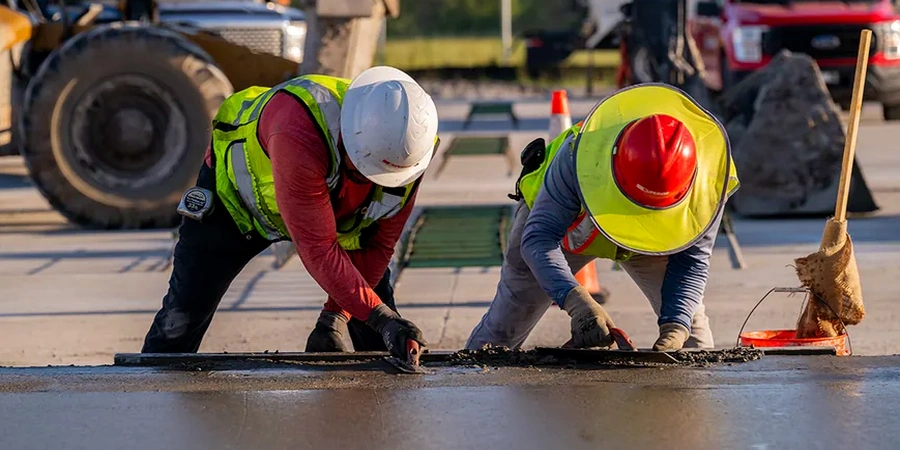
Typical technical challenges in Atlanta
The slipform paver is a familiar sight on Atlanta's new connector roads, its heavy track laying down a ribbon of concrete with millimeter precision. But the machine is only as good as the ground it rides on. The biggest risk we encounter is not the traffic loading but the loss of support beneath the slab due to erosion of the subbase. In the commercial strips around Cumberland and Perimeter Center, poor joint sealing allows surface water to infiltrate, saturating the fine-grained subgrade and pumping it out through the joints with each truck axle pass. This progressive erosion creates voids under the slab corners, leading to stress concentrations that the original fatigue design never anticipated. What makes Atlanta particularly tricky is the depth to the partially weathered rock layer, which can vary from 10 to 60 feet across a single site, creating differential support conditions that demand careful transition detailing at the pavement edges to avoid abrupt changes in slab deflection.
Our services
Our pavement engineering support in Atlanta covers the full lifecycle, from subgrade investigation through construction testing and forensic evaluation of distressed pavements. The following services are tailored to the specific demands of rigid pavement systems in the Piedmont region.
Concrete Mix Design and Performance Review
We review concrete mix designs for compliance with GDOT Section 500 requirements, focusing on aggregate durability, alkali-silica reactivity potential, and flexural strength gain curves. For high-early-strength patches on I-85 overnight closures, we verify that the specified 12-hour strength can be achieved without compromising long-term durability.
Joint Load Transfer and Diamond Grinding Assessment
On major arterials like Buford Highway, we conduct falling weight deflectometer (FWD) testing to evaluate load transfer efficiency across joints and cracks. When LTE drops below 60%, we develop diamond grinding and dowel bar retrofit plans to restore ride quality and structural capacity before the slab deteriorates beyond economical repair.
Common questions
What is the typical design life for a rigid pavement in Atlanta?
Most commercial and arterial rigid pavements in the Atlanta metro area are designed for a 30-year service life following the AASHTO 1993 method. The terminal serviceability index is typically set at 2.5. Achieving that lifespan depends heavily on maintaining joint seals and preventing subbase erosion, which is the primary failure mode we observe in older concrete pavements around the city.
Why do concrete pavements in Atlanta sometimes develop curling?
Curling is common here due to the daily temperature differential between the top and bottom of the slab, combined with the moisture gradients in the Piedmont clay subgrade. When the slab top cools faster than the bottom at night, the edges curl upward, losing subgrade support. This is exacerbated if the slab was placed on a poorly drained base that traps moisture. We specify a thicker slab and a permeable drainage layer to mitigate this effect.
What is the cost range for rigid pavement design services in Atlanta?
For a comprehensive rigid pavement design package including subgrade investigation, thickness design, joint layout, and construction specifications, the fee typically falls between US$1,890 and US$6,610. The exact cost depends on the project scale, the number of borings required, and whether forensic evaluation of an existing pavement is included.
How do you determine the required slab thickness for a warehouse with heavy forklift traffic?
For industrial floors and warehouse pavements, we move beyond the AASHTO highway models and use the PCA slab-on-grade method, which accounts for concentrated wheel loads from lift trucks. The design input includes the axle load, tire contact pressure, concrete flexural strength, and the modulus of subgrade reaction (k-value) determined from field plate load tests or correlations with our CBR data.