Compaction control in the Atlanta metro area requires strict adherence to ASTM D1556 — the sand cone method remains the reference standard for field density verification on projects ranging from GDOT roadbeds to commercial pad sites. The Piedmont residuum that underlies much of Fulton, DeKalb, and Cobb counties behaves differently than transported soils: its mica-rich, silty matrix demands careful moisture conditioning and lift thickness control. When a contractor places fill across these variable formations, a nuclear gauge reading alone is not always sufficient for acceptance, which is why the sand cone test provides the direct physical measurement that engineers and local jurisdictions trust. For deeper stratigraphic context on Piedmont profiles before fill placement, our team often coordinates field density campaigns with test pits to document natural ground conditions at planned subgrade elevations. The Atlanta climate adds another layer of complexity — afternoon thunderstorms in July can shift moisture content by several percent within hours, making real-time compaction verification essential for staying on schedule.
A sand cone test gives you the actual in-place density of the compacted lift — not a proxy, not a correlation curve, but the direct mass-to-volume ratio that governs long-term settlement performance.
Technical details of the service in Atlanta
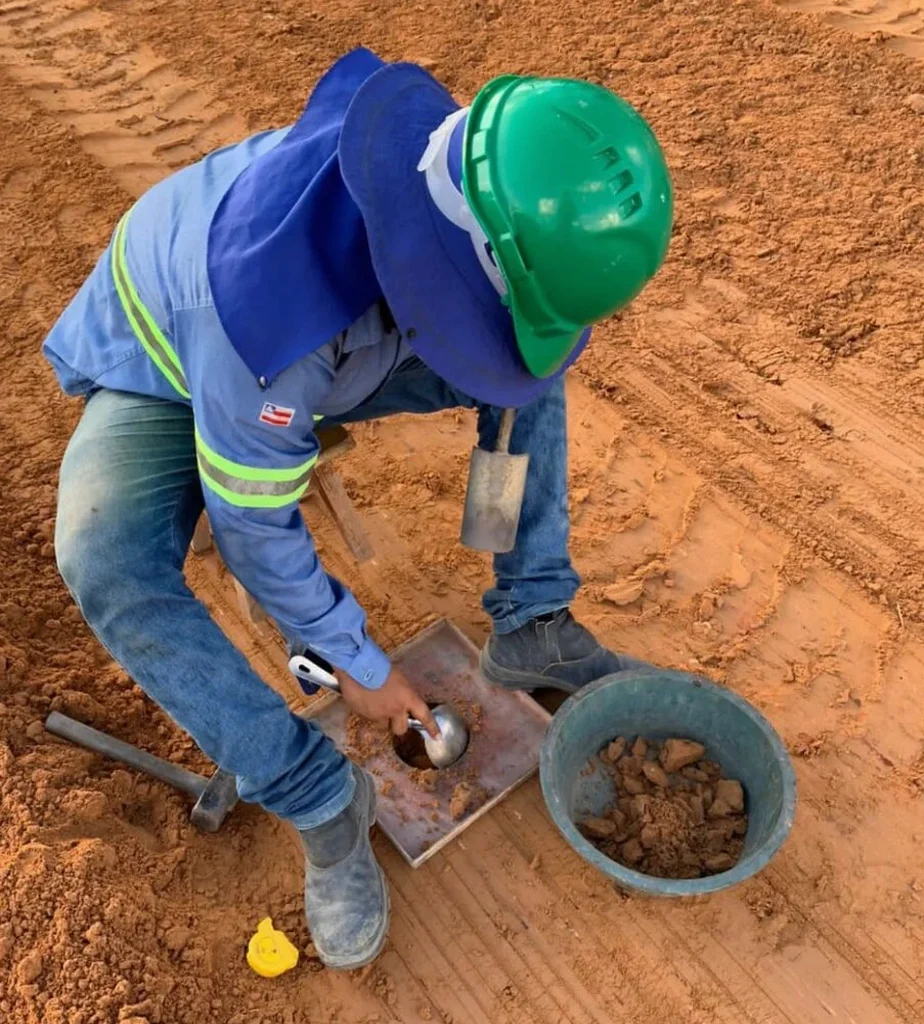
Typical technical challenges in Atlanta
The sand cone apparatus itself — a molded plastic or glass jar, a precision-machined metal cone valve, and a base plate with a 6.5-inch opening — looks deceptively simple, but its reliability depends entirely on operator technique and calibration discipline. In Atlanta's summer conditions, the calibration sand can absorb humidity from the air if not stored in sealed containers, altering its bulk density before it ever touches the test hole. Vibration from nearby compaction equipment, such as a Caterpillar CS56 roller passing within 20 feet of the test location, can densify the calibration sand inside the jar during the test, introducing a systematic error that underreports the excavated volume. The most common failure mode occurs on steeply sloping subgrades where the base plate cannot seat flush against the surface, allowing sand to escape laterally. For sites with high groundwater or perched water within the fill profile, the test hole may collapse before sand filling is complete. When compaction verification is part of a broader geotechnical compliance program — particularly on GDOT projects where compaction below 95% of modified Proctor maximum triggers rework — we often pair field density campaigns with rigid pavement design inputs to ensure the subgrade modulus assumptions match the as-built conditions that the density tests document.
Our services
Our field density testing program covers the full sequence from lab reference curves through in-place verification and final report submittal. Each service is calibrated to the specific soil types encountered across the Atlanta metro.
Compaction Acceptance Testing
ASTM D1556 sand cone tests performed at the frequency specified in the project compaction control plan, with same-day reporting of wet density, dry density, moisture content, and percent compaction relative to lab maximum. Suitable for structural fill under footings, slab-on-grade subgrades, and pavement sections.
Trench & Utility Backfill Verification
Density testing in confined excavations where nuclear gauges are impractical. We document lift-by-lift compaction in pipe zones, around vaults, and beneath curb-and-gutter sections, referencing City of Atlanta and GDOT backfill standards.
Laboratory Reference Curves (Proctor)
Standard and modified Proctor compaction tests (ASTM D698 / D1557) run on project-specific borrow and fill materials to establish the target maximum dry density and optimum moisture content against which all field density results are compared.
Common questions
How much does a field density test using the sand cone method cost per location in Atlanta?
A single ASTM D1556 sand cone field density test in the Atlanta area typically runs between US$100 and US$170 per test point, depending on site access, number of points scheduled per mobilization, and whether laboratory Proctor reference data is already available. Volume pricing applies for larger compaction verification programs.
What is the difference between a sand cone test and a nuclear density gauge reading?
The sand cone method measures soil density directly by determining the mass of excavated soil and the volume of the test hole using calibrated Ottawa sand — it is a primary measurement with no radiation source and no factory correlation curve. Nuclear gauges measure photon backscatter or transmission, which is faster but indirect; their readings depend on a calibration curve that may shift with soil chemistry. Atlanta's Piedmont soils, with variable mica and iron oxide content, can bias nuclear gauge results, which is why the sand cone remains the referee method for dispute resolution.
How many field density tests do I need for a commercial building pad in Atlanta?
GDOT and IBC-based specifications commonly require one field density test per 1,500 to 2,500 square feet per compacted lift, with a minimum of three tests per lift regardless of area. For a typical 20,000-square-foot commercial pad placed in 8-inch lifts, expect roughly 10 to 14 sand cone tests per lift. The project geotechnical engineer may adjust frequency based on material variability observed during earthwork.