Atlanta sits squarely in the Piedmont physiographic province, where the bedrock — predominantly biotite gneiss and schist — lies buried under a blanket of residual silty sands and stiff clays that can vary from 3 to over 20 meters deep within a single city block. We have pulled samples from Midtown sites where the saprolite completely retains the original rock texture yet crumbles under thumb pressure, a condition that plays absolute havoc with conventional fixed-base assumptions during even a moderate seismic event. The Modified Mercalli Intensity VI shaking recorded during the 1886 Charleston earthquake reached Atlanta and reminded the engineering community that the city is not immune to long-period ground motion, a reality we factor into every seismic microzonation study before recommending an isolation system.
A properly tuned isolation period of 3 to 4 seconds can drop base shear demands on a 15-story Midtown tower by over 60 percent compared to a fixed-base design on the same Piedmont profile.
Technical details of the service in Atlanta
Typical technical challenges in Atlanta
We walked a 10-story steel moment frame on Peachtree Street where the original fixed-base design assumed Site Class C but the borings revealed 14 meters of saprolitic silty sand with V_s30 values dipping into Site Class D territory. The calculated interstory drift under the design earthquake jumped past the 2 percent limit at the fourth floor, right where the stiffness irregularity kicks in. Converting the foundation to a triple friction pendulum system let us lengthen the effective period past 3.5 seconds and cap the superstructure drift below 1.2 percent without adding a single brace. The biggest risk we see in Atlanta is not the isolation hardware itself — it is the assumption that Piedmont residual soil behaves like rock once the SPT N-value exceeds refusal; the strain-softening behavior of cemented saprolite under cyclic loading can surprise even experienced geotechnical engineers.
Our services
Our Atlanta laboratory and field team handles the full chain from subsurface characterization through nonlinear time-history analysis to prototype isolator testing, always calibrated to the quirks of Piedmont geology.
Site-Specific Seismic Hazard and Response Spectra
Probabilistic and deterministic seismic hazard analysis for downtown Atlanta sites, generating uniform hazard spectra and site-specific ground motions per ASCE 7-16 Chapter 21 that capture the long-period energy critical for isolation design.
Isolation System Design and Peer Review
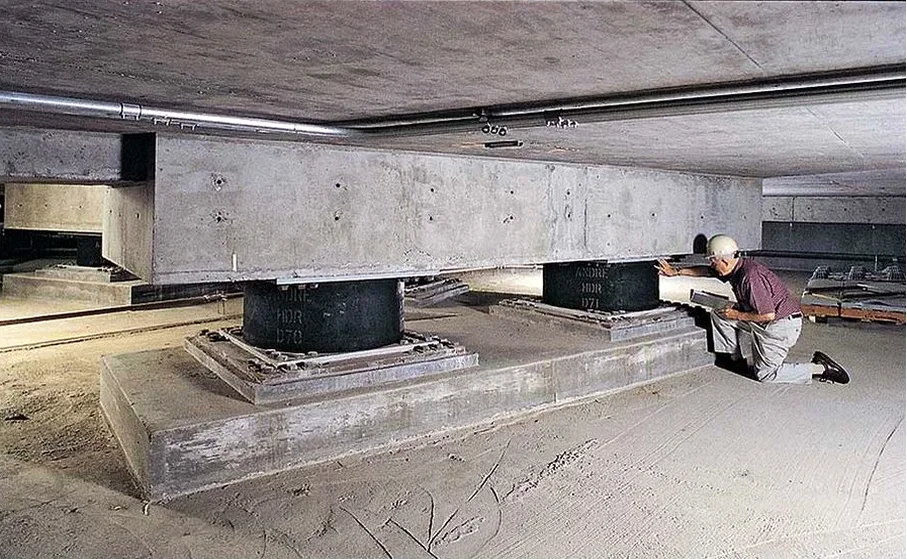
Nonlinear time-history modeling of lead-rubber, high-damping rubber, and friction pendulum systems in ETABS or SAP2000, including stability checks under MCE_R displacement and peer review documentation for the Atlanta building department.
Geotechnical Laboratory Characterization for Isolator Foundations
Cyclic direct simple shear, resonant column, and bender element testing under our ISO 17025 scope to define the stiffness and damping of Piedmont residual soils at the strain levels relevant to isolator pedestal response.
Construction-Phase Testing and Long-Term Monitoring
Prototype isolator testing per ASCE 7-16 Section 17.8, plus instrumentation plans that track isolator displacement, temperature, and drift over the first five years of building operation.
Common questions
What does a base isolation study for an Atlanta mid-rise typically cost?
For a 6- to 12-story building on a typical Piedmont site, the full scope — site-specific hazard analysis, nonlinear isolator modeling, peer review report, and prototype testing protocol — falls in the range of US$4,580 to US$7,460, depending on the number of ground motion pairs required and whether downhole geophysics is needed to refine the site class.
How does the Piedmont residual soil affect isolator displacement?
Piedmont saprolite tends to be stiffer at small strains than alluvium, which is good for bearing, but it can amplify ground motion at periods of 1 to 2 seconds when the profile is deep. We run site response in DEEPSOIL to capture that amplification; ignoring it often underestimates MCE displacement by 15 to 20 percent.
Do Atlanta building officials require peer review for base-isolated structures?
Yes — the City of Atlanta follows IBC 2021, which mandates independent peer review for seismically isolated structures assigned to Risk Category III or IV. We coordinate the peer review panel and produce the required design criteria and test reports as part of the permit package.
Can you test the isolators before installation?
Absolutely. The prototype tests specified in ASCE 7-16 Section 17.8 — including three full cycles at the design displacement and the full MCE displacement test — are run at an accredited laboratory. We witness the tests, review the hysteresis loops, and incorporate the actual bearing properties into the final nonlinear model before the shop drawings are released.