Atlanta's skyline didn't rise on bedrock alone. The 1996 Olympic construction push exposed how abruptly Piedmont saprolite transitions from stiff residual silt to partially weathered rock—sometimes within a single borehole. Since then, the Standard Penetration Test has become the first line of investigation for any mid-rise or infrastructure project inside the Perimeter. Our crews operate CME-75 and Diedrich D-120 rigs with automatic trip hammers calibrated to ASTM D1586-18, delivering energy-corrected N60 values instead of raw blow counts. For sites near the Chattahoochee River floodplain, where Holocene alluvium masks deeper weathered profiles, we often pair SPT sampling with CPT soundings to resolve thin sand seams that split-spoon recovery misses.
Energy-corrected N60 values from SPT testing in Atlanta's Piedmont saprolite are what separate a conservative footing design from a geotechnical surprise during excavation.
Technical details of the service in Atlanta
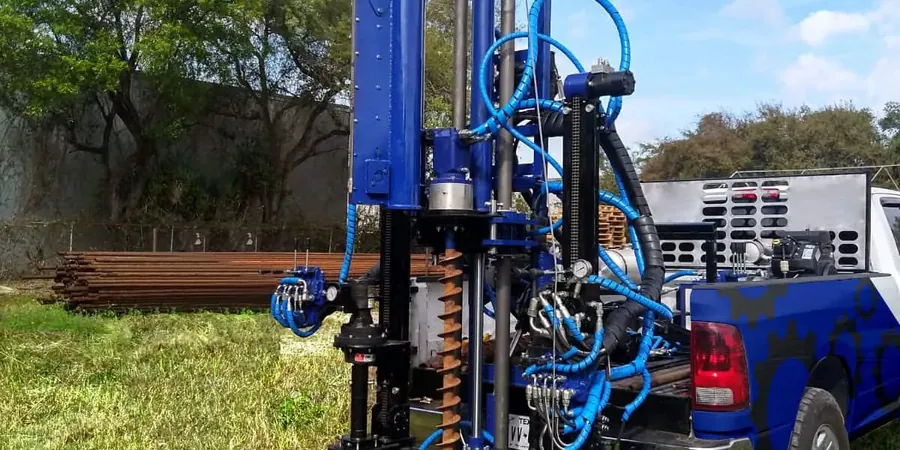
Typical technical challenges in Atlanta
In Atlanta's zone of weathered Piedmont rock, the biggest mistake we see is stopping a boring at N=50 refusal and calling it bedrock. Partially decomposed granite and mica schist often produce refusal-like blow counts for two or three feet, then drop back into weathered material with N-values in the high 20s. We core through refusal zones with an NX diamond bit to confirm competent rock—otherwise the designer sets the pile tip elevation too shallow, and the structure settles differentially. Another common issue occurs in the fall construction season when residual soils dry out and SPT results run artificially high. We address this by reporting moisture condition alongside N60 and by running moisture-density comparisons when the field log suggests desiccation.
Our services
We structure SPT investigations around what foundation engineers actually need for Atlanta projects—not just a log of blow counts. The scope adjusts to site geology and structural load complexity.
Geologic-Specific SPT Program Design
Borehole layout and depth tailored to Piedmont saprolite mapping, with closer spacing near mapped fault traces or alluvial terrace scarps. Includes IBC seismic site class determination from N60 profiles.
Instrumented SPT with Energy Calibration
Hammer energy measured via PDI analyzer or load cell to compute corrected N60. Essential for liquefaction triggering analysis per NCEER/Youd-Idriss 2001 when loose sands appear in Chattahoochee corridor borings.
SPT-Based Foundation Parameter Reports
Direct correlation to drained friction angle (Hatanaka & Uchida 1996), undrained shear strength (Terzaghi & Peck), and constrained modulus for shallow footing settlement estimates. We flag outlier N-values caused by gravel-sized mica fragments common in DeKalb County saprolite.
Common questions
How much does an SPT test program cost for a typical Atlanta building site?
For a single-family or light commercial lot inside the Perimeter, a three-borehole SPT program with logs, USCS classification, and an N60 foundation recommendation letter typically runs between US$620 and US$660 per borehole. The total depends on access constraints, traffic control permits if drilling within the public right-of-way, and whether you need deeper borings for a basement level or elevator pit.
What makes SPT results in Atlanta's Piedmont geology different from coastal plain sites?
Piedmont residual soils retain relict rock structure—mica schist in Atlanta produces angular, plate-like particles that increase friction but also cause erratic blow counts when the split spoon hits a mica-rich seam. Coastal plain sediments, by contrast, are transported and layered, giving more predictable N-value profiles. That is why we visually log every spoon recovery and note mica content, rather than relying solely on the blow count number.
How many SPT borings does IBC require for a commercial building in Atlanta?
IBC 2024 Table 1803.1 requires a minimum of one boring for every 2,500 square feet of building footprint for structures up to 5 stories, with a minimum of three borings total. Spacing typically ranges from 50 to 100 feet depending on soil variability. For sites within the Brevard Fault zone influence area, the geotechnical engineer of record often tightens that spacing because saprolite depth can change 20 feet across a single building pad.