Atlanta sits on the Piedmont physiographic province, where the bedrock lies beneath a thick mantle of residual silty sands and micaceous silts. This weathered profile, often extending 20 to 80 feet, demands precise effective stress parameters that standard penetration tests alone cannot deliver. A consolidated-undrained triaxial test with pore pressure measurement reveals the true friction angle of these saprolitic soils, which governs deep excavation stability and pile skin friction in the metro area. The bulk of Atlanta's commercial foundations interact with partially saturated silts whose strength drops sharply when water tables rise after heavy summer storms. We run multi-stage triaxial programs to capture this behavior, providing the data structural engineers need to avoid overconservative designs that inflate project costs unnecessarily.
A 2-degree error in the effective friction angle can shift a retaining wall's factor of safety by 15 percent in Atlanta's micaceous silts.
Technical details of the service in Atlanta
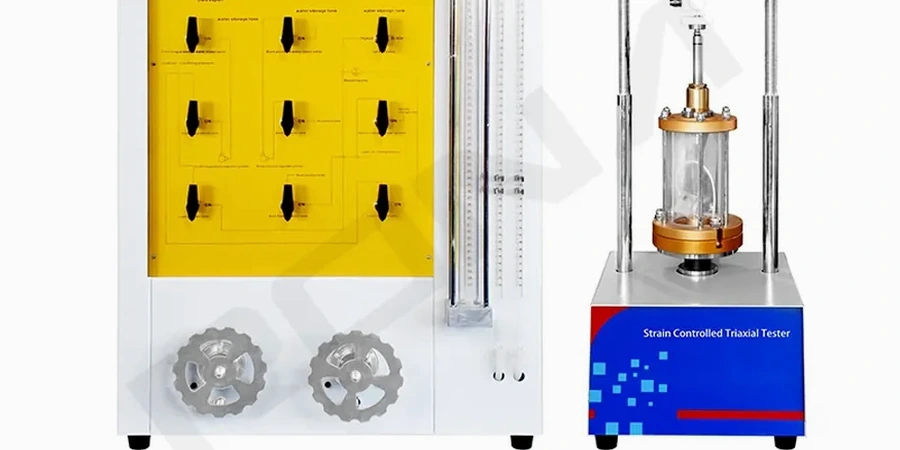
Field demonstration
Typical technical challenges in Atlanta
The International Building Code, as adopted by the City of Atlanta, requires rational shear strength parameters for any foundation deeper than 12 feet or when the design bearing pressure exceeds 3,000 psf. Guessing friction angles from blow counts alone creates two failure modes in Piedmont residual soils. First, an overestimated friction angle leads to underdesigned footings that settle differentially when the soil structure collapses upon wetting. Second, an underestimated cohesion intercept forces unnecessary deep foundations or over-excavation in sites where the saprolite retains enough cementation to stand vertically for weeks. Both mistakes cost money and schedule. The triaxial test eliminates this gamble by measuring pore pressure response during shear, which reveals whether the soil contracts or dilates at the design stress level. Atlanta's undulating topography also means many projects cut into weathered rock transitions where drained and undrained behavior flip within a few vertical feet, making a single triaxial suite far cheaper than the risk of a slope failure during a summer thunderstorm.
Our services
Our Atlanta triaxial testing program covers the full range of shear strength determination needed for local geotechnical reports. Every test is run on calibrated load frames with digital data acquisition and reviewed by a senior technician before the report leaves the lab.
Consolidated-Undrained Triaxial with Pore Pressure
ASTM D4767 multistage testing on Shelby tube samples. Provides effective stress parameters c' and φ' for drained analysis of slopes, retaining walls, and deep excavations in Atlanta's residual silts.
Unconsolidated-Undrained Triaxial
ASTM D2850 quick shear tests for total stress analysis of short-term excavation stability and end-of-construction bearing capacity in saturated Piedmont soils.
Consolidated-Drained Triaxial
Drained shear with volume change measurement for long-term slope stability and soil-structure interaction where Atlanta's saprolite will fully drain over the design life.
Triaxial with Small-Strain Measurement
On-sample LVDTs or Hall effect transducers to capture E_50 and shear modulus at 0.1 percent strain, used for finite element modeling of mat foundations under tall buildings in Midtown Atlanta.
Common questions
What does a triaxial test cost in Atlanta?
A standard three-stage consolidated-undrained triaxial test on an undisturbed Shelby tube sample typically ranges from US$1,890 to US$2,700 in Atlanta. The final price depends on the number of confining stages, whether pore pressure measurement is included, and the urgency of the turnaround. Samples requiring special trimming due to gravel or mica seams in the Piedmont saprolite may fall at the upper end of that range.
Which ASTM standard applies for triaxial testing on Atlanta residual soils?
We run ASTM D4767-11 for consolidated-undrained tests with pore pressure measurement, which is the standard relevant to most Atlanta foundation designs. For quick undrained checks on soft cohesive layers, we use ASTM D2850-15. The City of Atlanta building department accepts both standards when the test report includes the complete stress-strain curves and Mohr-Coulomb plots.
How many samples do you need for a reliable triaxial shear strength profile?
For a typical Atlanta commercial building site with 40 to 60 feet of Piedmont residual soil, we recommend one triaxial suite per distinct soil layer encountered in the boring logs. That usually means two to three undisturbed Shelby tube samples per boring, taken from the upper silty sand, the intermediate saprolite, and the partially weathered rock transition. Running a single test across a 50-foot profile misses the strength variability that governs pile length and footing size decisions.
How long does triaxial testing take from sample delivery to final report?
Standard turnaround is 7 to 10 business days. Consolidated-drained tests take longer because the shear stage must be slow enough to prevent pore pressure buildup. Expedited 5-day service is available when the drilling crew is still on site and the foundation contractor needs preliminary parameters to order steel and concrete.